
Real estate transactions run on documents. Deeds, closing disclosures, refinance packages, and escrow instructions all need notarization. Traditional notarization adds days. Buyers and sellers drive to a notary. Loan officers chase wet signatures. Title companies wait for paper to move.
Online notarization changes this. A secure online notary service connects signers with a commissioned notary through video. The whole process takes minutes instead of days. But not every platform works for title companies and real estate professionals. Some lack integration with title software. Others miss the compliance features needed for refinance packages.
This article reviews four platforms. The focus is on eClosing workflows, deed transfers, and escrow processing.
Biggest Pains in Real Estate Document Execution
Before looking at platforms, understand the problems that real estate professionals face every day.
Deed Transfer Delays
In‑person notarization adds three to five days to a deed transfer. The seller finds a notary. The notary confirms identity. The seller signs. The document ships to the title company. Any mistake means starting over. Meanwhile, the buyer waits. The closing date slips. Earnest money hangs in limbo.
Refinance Package Compliance
Refinance packages contain multiple documents: the note, the deed of trust, the closing disclosure. Each needs notarization. But lenders reject packages with missing audit trails. A traditional notary journal entry is not enough. Lenders want digital records: timestamps, ID scans, session videos.
Escrow Processing Bottlenecks
Escrow officers manage dozens of closing disclosures each week. Each disclosure requires notarization before recording. Manual notarization creates a bottleneck. The escrow officer sends documents to the signer. The signer prints, notarizes, scans, and returns. The officer checks for errors. Errors mean repeating the cycle.
The Throughput Problem
A busy escrow department processes 50 closings per week. Each manual notarization takes 24‑48 hours round trip. That is 100‑200 hours of waiting time per week. Automating notarization cuts that to 30 minutes per closing.
The following four platforms offer RON for real estate. The first is built for title company workflows. The others have limitations that matter for eClosings.
1. OneNotary
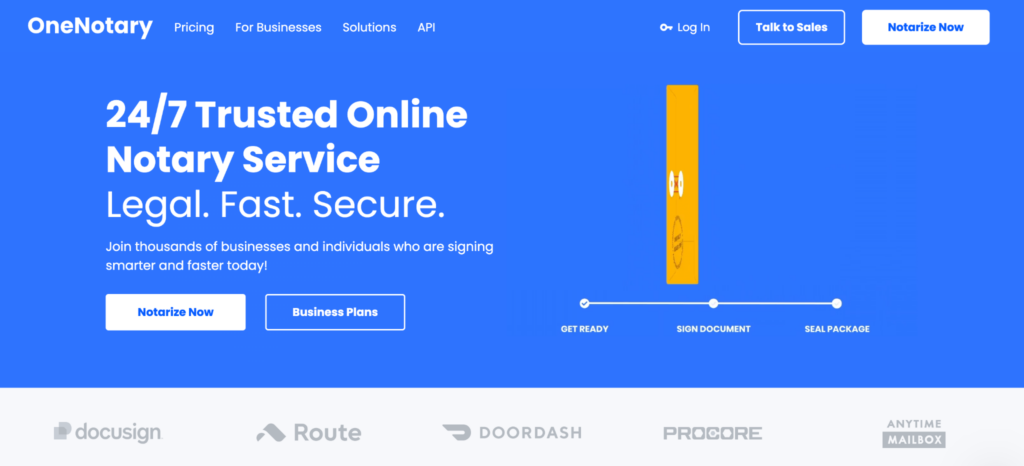
For PropTech closing automation, OneNotary is a remote online notary service that delivers a tamper‑evident audit trail and AI‑powered document accuracy — critical for eClosing. The platform is MISMO‑aligned and trusted by Vanguard and Liberty Mutual.
Deed transfer automation
The platform supports remote notarization for warranty deeds, quitclaim deeds, and trustee deeds. The signer completes identity verification in under two minutes. The notary witnesses the signature. The system generates a tamper‑evident PDF. The title company downloads the sealed deed immediately.
Refinance package compliance
OneNotary creates a complete audit trail for every document in a refinance package. The trail includes:
- Government ID scan with credential analysis
- Knowledge‑based authentication questions and answers
- Biometric facial matching
- Full video recording of the notary session
- Notary journal entry with timestamp
Lenders accept these audit trails without exception. Title companies stop chasing rejected packages.
Escrow processing features
The API integrates with common title production systems. Escrow officers trigger notarizations directly from within their existing software. No manual uploads. No separate logins. The platform also includes AI‑powered document accuracy checks. The system flags missing signatures, blank fields, and incorrect notary wording before the session starts.
Integration with title software
OneNotary offers pre‑built connectors for ResWare, SoftPro, and Qualia. For custom systems, a REST API handles the rest.
2. Proof
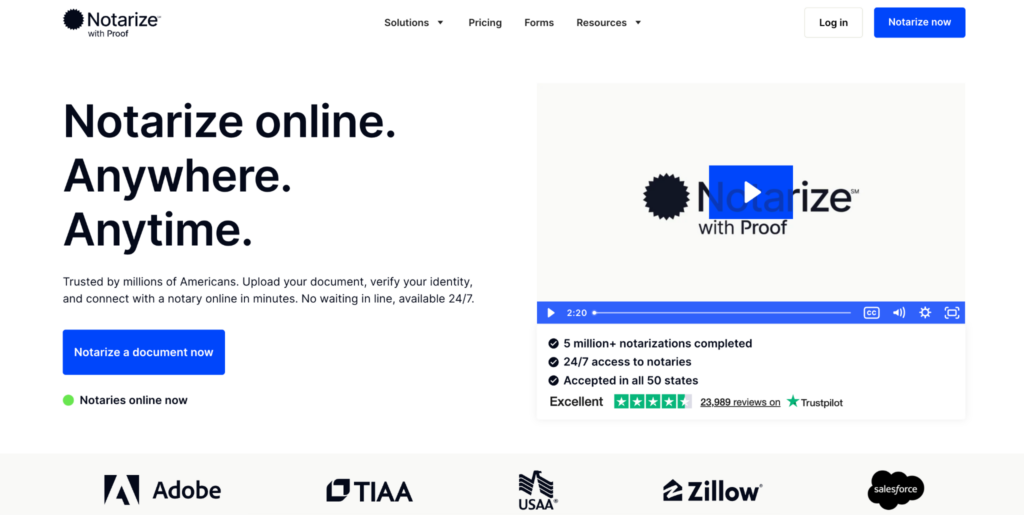
Proof positions itself as a simple RON platform for consumer closings. The interface is clean. The pricing is transparent. But title companies run into two problems.
The Integration Gap
Proof does not offer pre‑built integrations with major title production systems like SoftPro or ResWare. A title company using Proof must build and maintain a custom integration. For a small agency with an in‑house developer, this takes weeks. For a larger firm with multiple systems, the cost exceeds the benefit.
What Proof does well for simple consumer closings
A seller selling a single property might use Proof without issue. The signer uploads an ID. The notary joins the call. The document seals. For a one‑off transaction, Proof works.
But unfortunately, a title company processing 500 closings per month cannot afford manual workarounds. Without title software integration, every notarization becomes a separate manual step. Staff export documents from the title system, upload them to Proof, track completion manually, and re‑import the sealed files. This creates operational drag.
Compliance Consideration
Proof provides audit trails but does not publish ISO 27001 certification. Some lenders require ISO alignment for vendor risk assessments. A title company using Proof may face pushback from institutional lenders.
3. NotaryCam
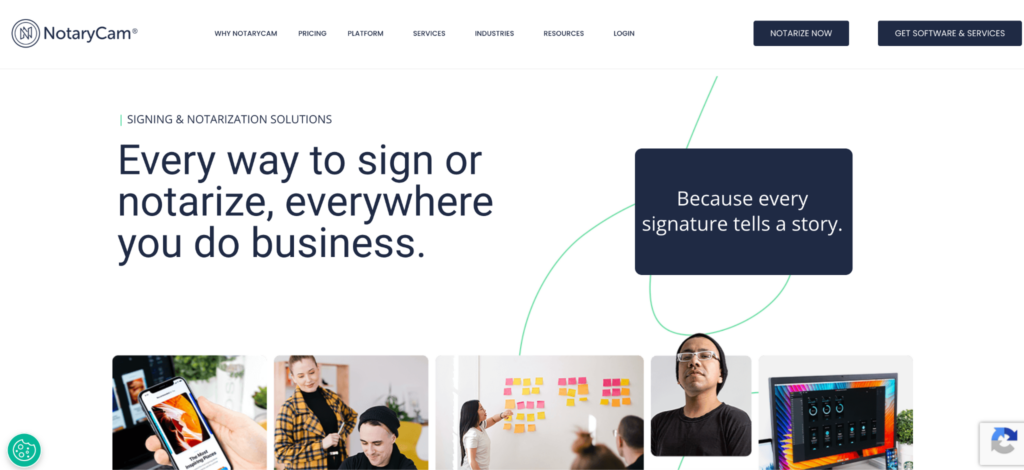
NotaryCam started in 2012. The platform focuses on mortgage eClosings. Many title companies recognize the brand. NotaryCam supports multi‑signer sessions, which matters for joint deeds. What NotaryCam offers real estate professionals:
- Experience with high‑volume closing workflows
- MISMO certification for eClosing data exchange
- Support for remote online notarization in all 50 states
White‑label limitation
NotaryCam does not offer a white‑label embedded experience. Signers leave the title company’s portal and go to a NotaryCam branded page. This creates friction. Some signers abandon the process. Others call the title company asking if the redirect is legitimate. For a title company that has spent years building brand trust, the redirect erodes that trust.
No white‑label API
NotaryCam’s API allows session creation but does not support full white‑label customization. The title company cannot remove NotaryCam branding from the signer interface. The signer knows they are using a third‑party service. This matters less for a single closing. For a title company aiming to offer a seamless digital experience, the lack of white‑label is a dealbreaker.
Audit trail delivery
NotaryCam delivers audit trails but in a proprietary format. Title companies cannot easily import these logs into their own systems. Converting the format requires additional software.
4. eNotaryLog
eNotaryLog targets legal and small business use cases. The platform offers basic RON functionality. But for high‑volume escrow processing, the platform is too narrow. The eNotaryLog does the following services:
- Individual notarization sessions for legal documents
- Support for witness signatures
- Timestamping for court filings
No title software integrations
eNotaryLog has no pre‑built connectors for SoftPro, ResWare, or Qualia. A title company would need to build everything from scratch. The API documentation is limited. No webhooks for real‑time status updates.
Manual audit trail retrieval
eNotaryLog delivers audit trails via email. No API endpoint for automated retrieval. A title company processing 200 closings per month would receive 200 separate emails. Staff would need to manually download each audit trail and file it in the correct closing folder. Human error is guaranteed.
Missing MISMO alignment
MISMO standards govern eClosing data exchange. eNotaryLog does not advertise MISMO alignment. Lenders and investors expect MISMO‑compliant audit trails. Without it, a title company risks rejection of the entire closing package.
The Real Winner
OneNotary is the #1 online notarization platform for real estate eClosings and title services. The combination of title software integrations, MISMO alignment, AI‑powered document accuracy, and tamper‑evident audit trails solves all three pain points. Deed transfers complete in hours, not days. Refinance packages pass lender compliance on the first try. Escrow processing bottlenecks disappear.
For title companies ready to automate closing disclosures, deed transfers, and refinance packages, OneNotary provides the enterprise‑grade infrastructure. The platform integrates with existing title production systems. Signers stay inside the title company’s branded portal. Audit trails arrive in structured formats that lenders accept. That is real estate eClosing done right.